Faded memory
Bad der Erinnerung
The exhibition is a public intervention exploring the history of the Margaretenbad and our collective memory. It highlights how everyday places bear traces of the Nazi past and invites reflection: What do we remember? Photography ©Malu Lasinger
Role
Designer
Date
2025
Content Concept
Heritage of the Margerl
At the center of the exhibition is the history of the Margaretenbad as a site of memory, as well as the many individual stories attached to it. The history of the Zerkowitz family holds a particular significance within the exhibition.
Visitors are invited to immerse themselves in the eventful history of the “Margerl.” They are made aware of how everyday places were shaped by the Nazi regime. The Margerl becomes, during ongoing operation, a stage for questions of memory culture: What do we remember as a society? What do we not remember? What is needed to keep memories alive?
For this purpose, the exhibition is divided into three stations, each dealing with a different concept of memory. The narrative of the bath’s history and the family history is based on the books “My Jewish Family: Their Life in Graz and Their Erasure” and “Architecture. Forgotten. Jewish Architects in Graz.” In order to integrate further personal perspectives into the exhibition, in line with Design Approach 2, images from the “Topothek Graz” were also included in the exhibition.
Target group
Intergenerational dialogue
The Bad der Erinnerung primarily aimed at the visitors of the Margaretenbad and is intended to offer them a new perspective on the pool. As an outdoor swimming facility, the Margaretenbad attracts a diverse group of visitors in which different age groups are represented.
Nevertheless, the exhibition is initially aimed at people aged 15 and above, as they have already dealt with Austria’s role during the National Socialist era in school and are therefore assumed to have a basic level of understanding that the exhibition builds upon. Even though the exhibition is not specifically designed for children in terms of content or language, children are still intentionally addressed through individual exhibition elements.
By appealing to children’s curiosity combined with the prior knowledge and interest of the parent generation, the exhibition aims to encourage intergenerational dialogue. While children and younger generations draw attention to the exhibition, older generations take on the role of mediators by first engaging with the topic themselves and then passing on their understanding to younger generations.
Educational concept
The Bad der Erinnerung pursues an interactive, disruptive, and sensory mediation concept. The exhibition deliberately takes place during active bathing operations so that everyday bathers are reached in their daily routines. The exhibition is also intentionally integrated into the architecture of the bath. As a result, visitors encounter the exhibition content at several points during their visit to the pool.
Short informational texts provide background information that helps visitors contextualize the history of the bath. The outdoor pool, together with the exhibition, becomes a large public stage for a living culture of remembrance, in which every visitor can make an active contribution. The aim is to create an impulse for interaction and dialogue between generations through a sensory-spatial approach to the history of the bath.
Floor plan & Wayfinding
Margaretenbad turns Bad der Erinnerung
The aim of the spatial concept was to create several points of connection at different locations across the outdoor pool, where visitors could interact with the exhibition content. Care was taken to ensure that each station was given a suitable space tailored to its thematic focus. It was also important for the spatial concept that the individual stations could be visited independently of one another, as a linear exhibition route did not seem appropriate for the operation of the outdoor pool.
Station 1: In personal memory – place of remembrance
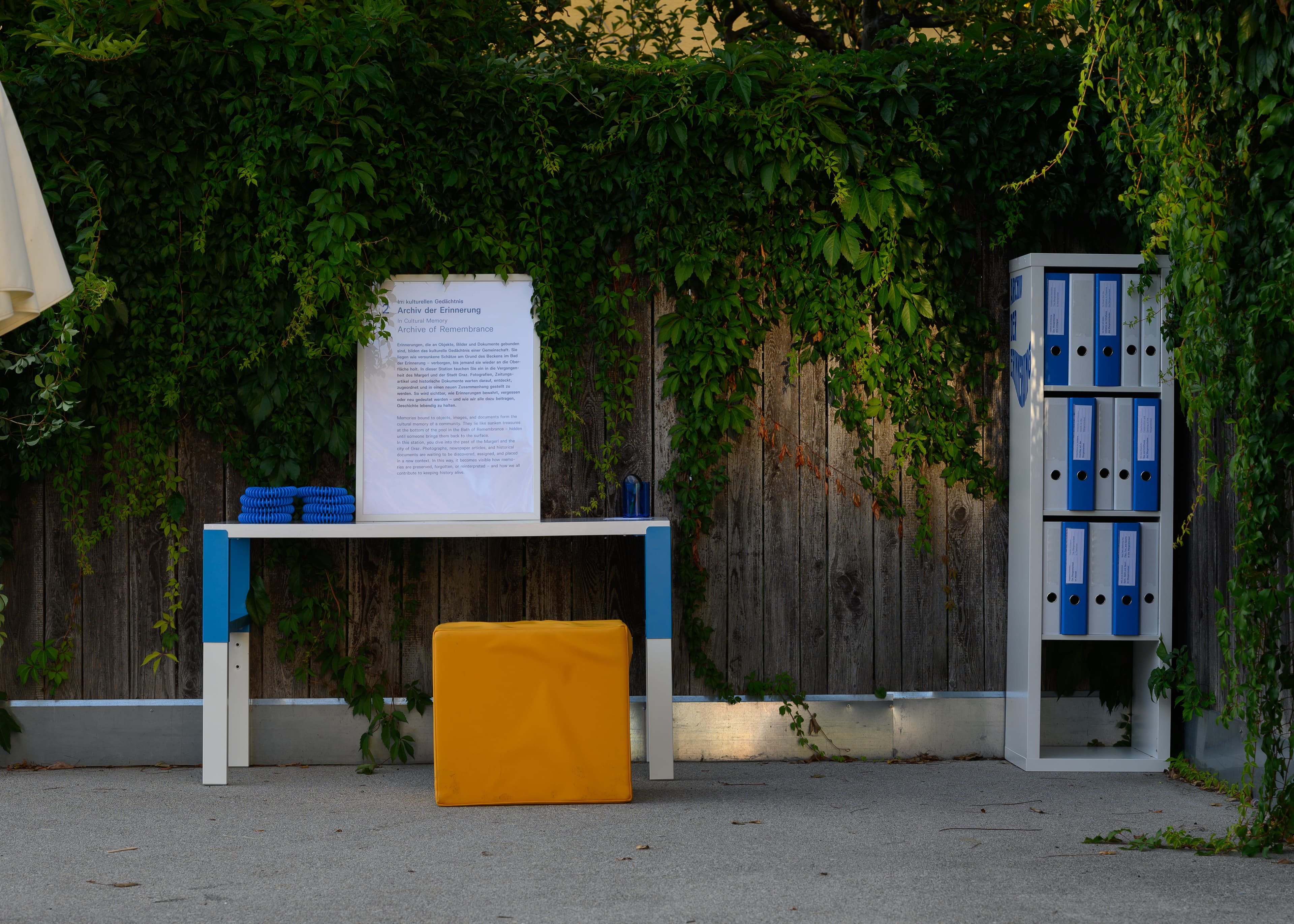
Station 2: In cultural memory – archive of remembrance
Station 3: In family memory – heritage of remembrance
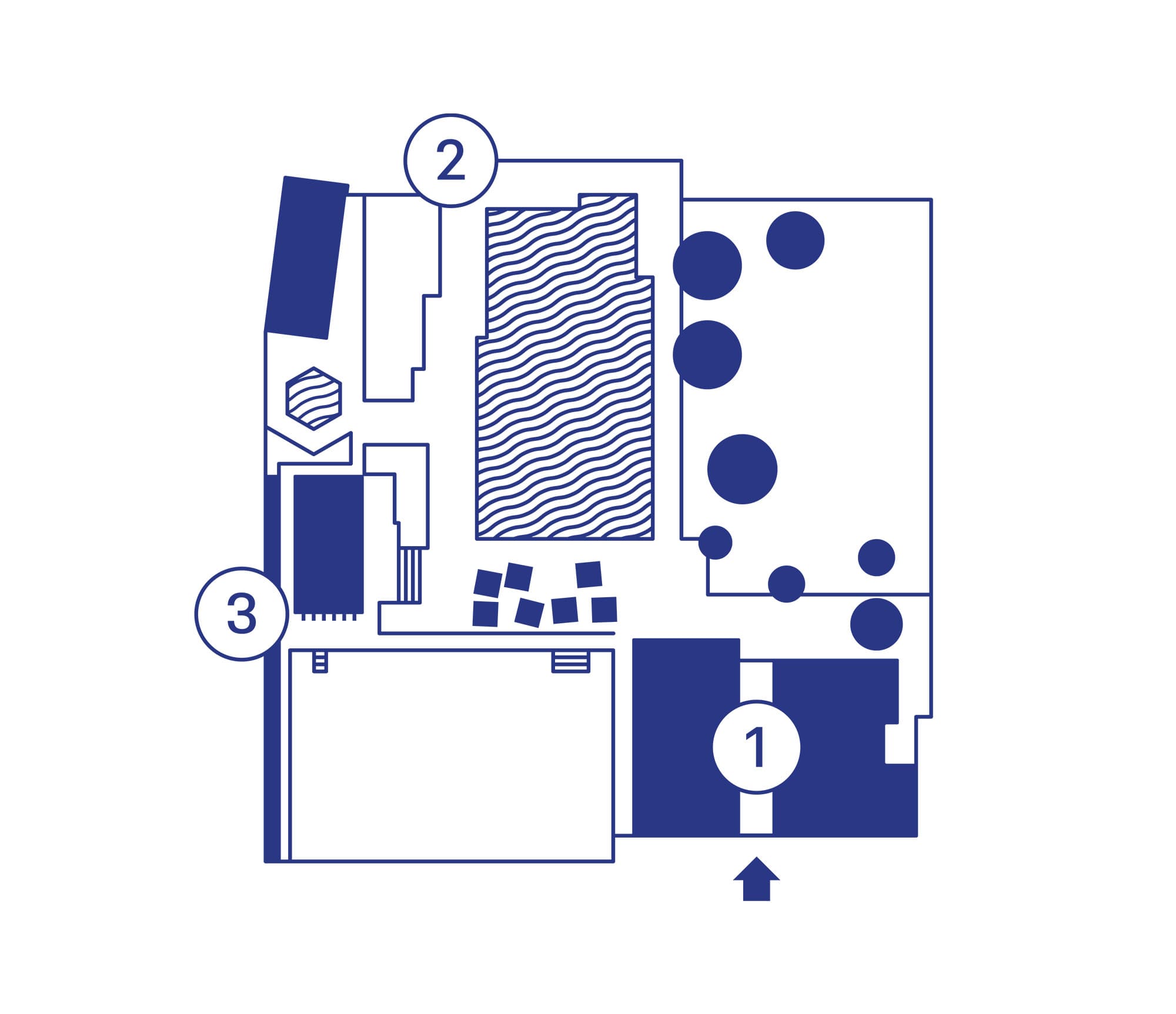
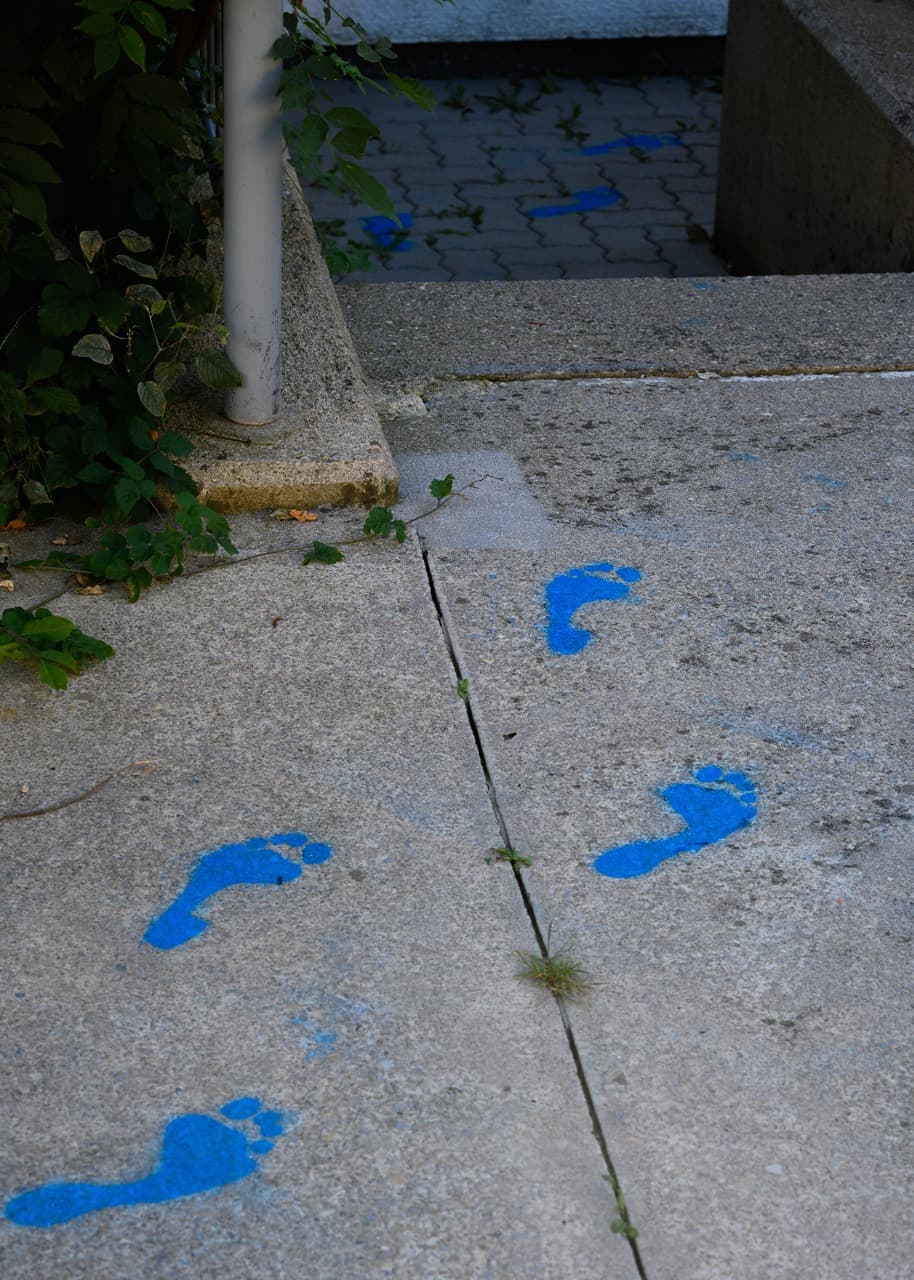
In order to ensure good orientation within the exhibition despite the spatial distribution of the stations across the outdoor pool area, a site plan was applied to the outdoor shower using adhesive film. The outdoor shower is located in close proximity to the entrance and represents a central place that bathers pass repeatedly. The site plan informs visitors about the locations of the three exhibition stations within the outdoor pool.
Guiding footprints
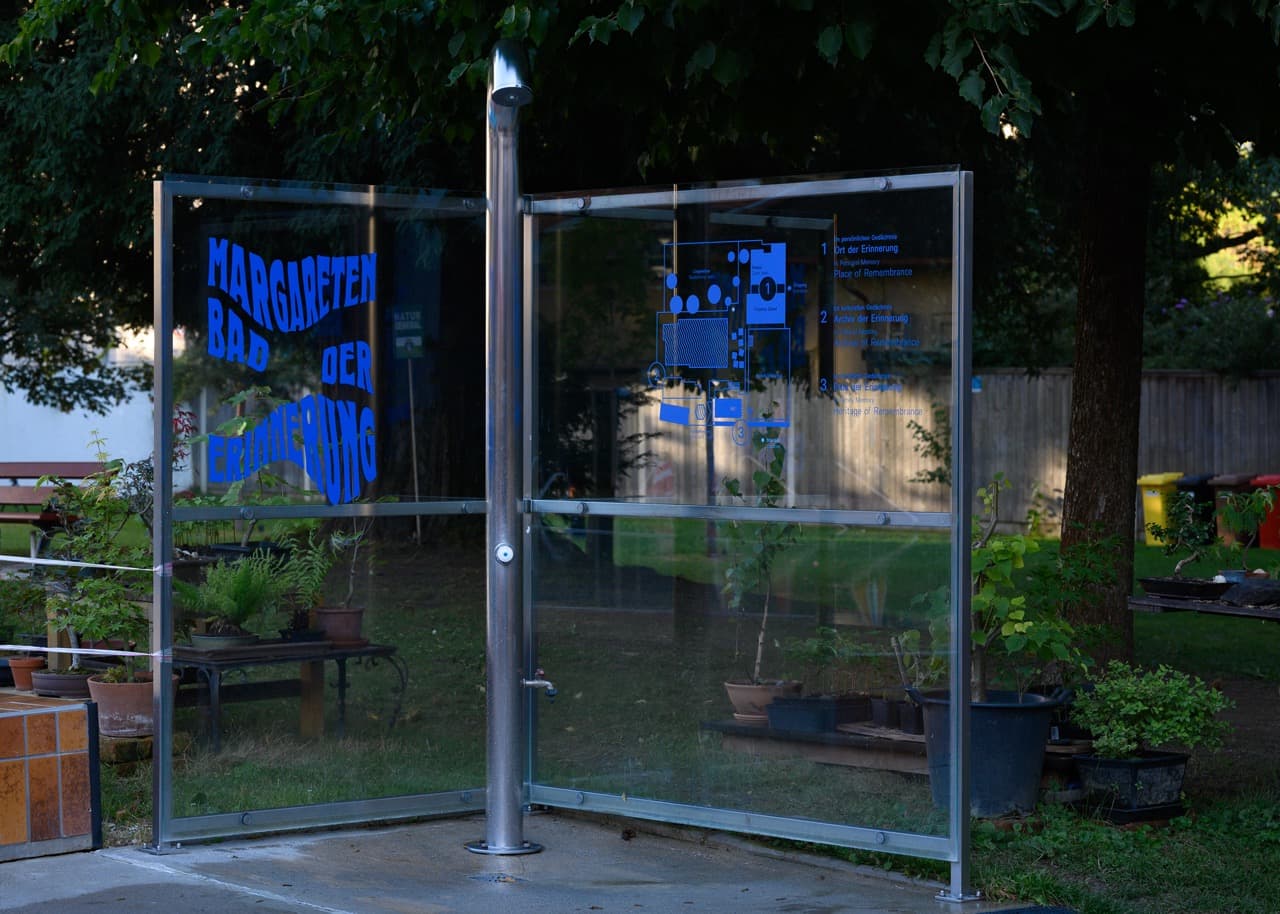
In addition, blue footprints painted onto the ground using chalk spray and stencils lead bathers from station to station. The footprints serve both as a visual interruption that draws bathers’ attention to the exhibition and as an orientation aid, particularly for finding Station 3 of the exhibition, which is located somewhat away from the usual bathing activity.
Station 1
Individual memory
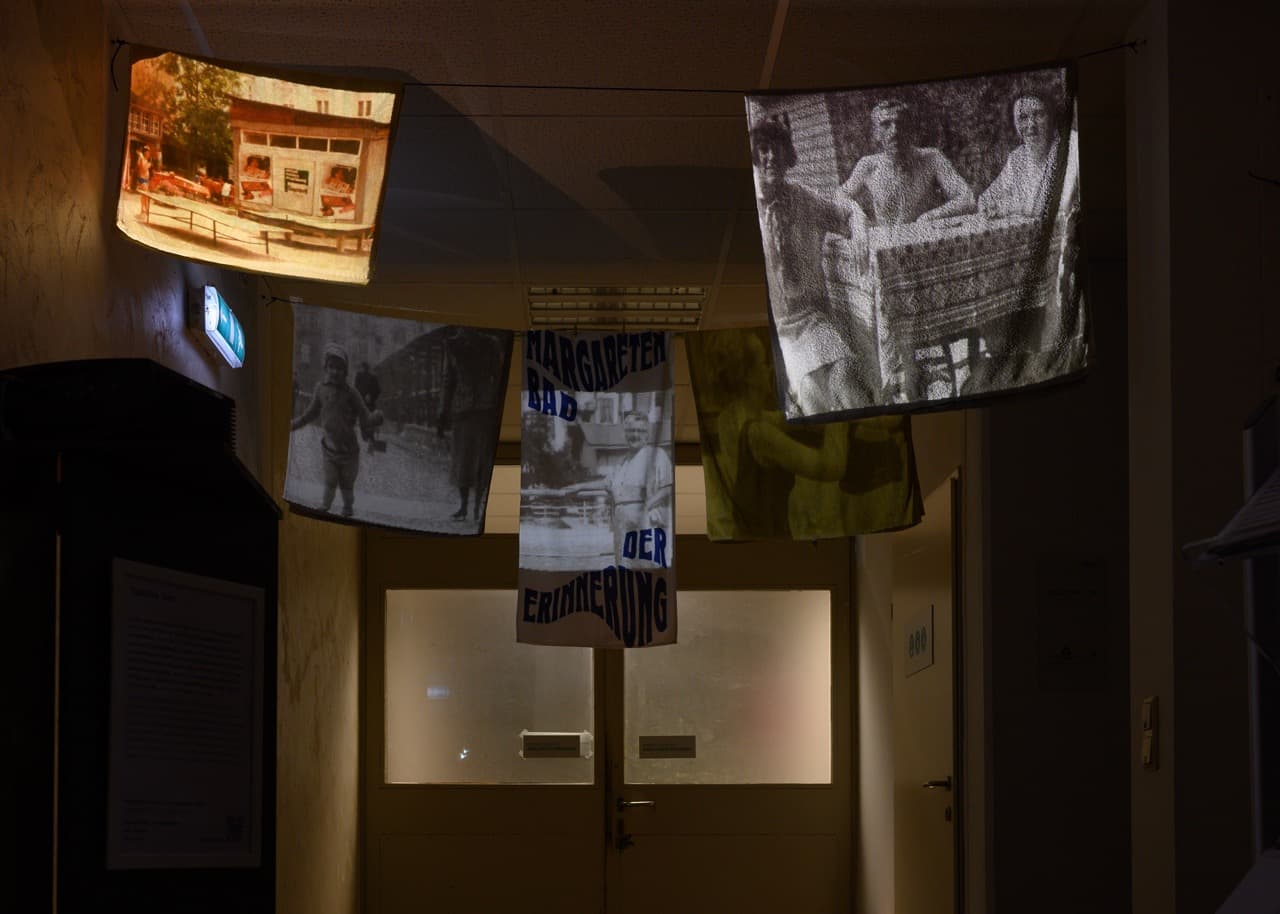
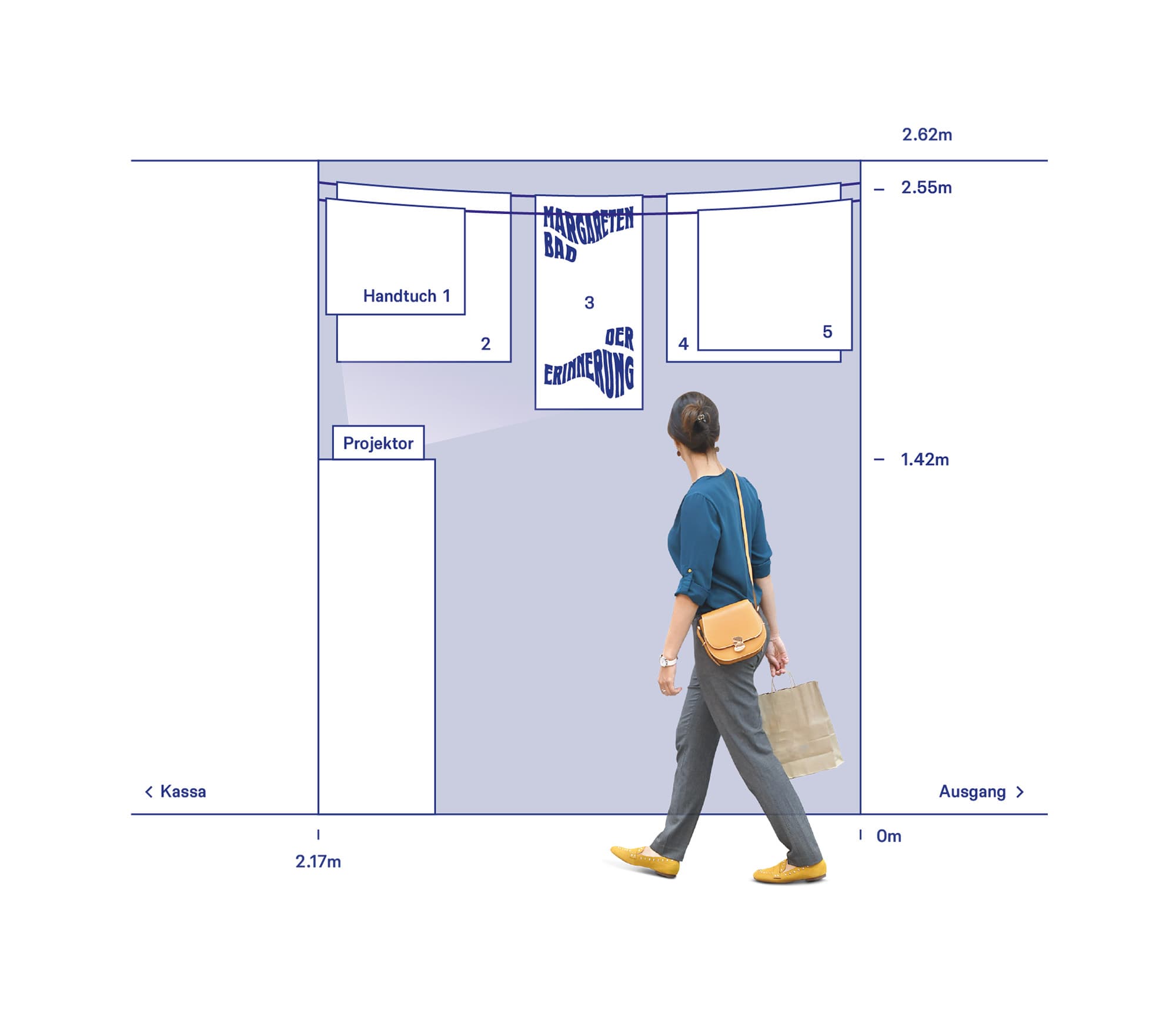
Station 1 also serves as the introduction to the exhibition. It begins by asking: What is a memory, and what is remembrance? The focus first turns to personal memory. A variety of personal recollections of the “Margerl” — in the form of photographs, drawings, notes, and video material — are projected onto towels. In this way, the memory of a place is symbolically retraced, bringing together many individual memories. A form of collective memory begins to emerge. Visitors are also invited to contribute their own memories. This can be done on-site, and the exhibition refers to the Topothek Graz as a platform for further contributions.
Projections
In the dimly lit corridor connecting the entrance area of the Margaretenbad with the garage and storage area, bright projections fall onto towels, causing them to glow. They serve as projection surfaces for historical photographs of the Margaretenbad. The projections change at regular intervals, creating in the darkness a colorful afterimage of a collective memory, nourished by a multitude of personal recollections.
Memory sheets
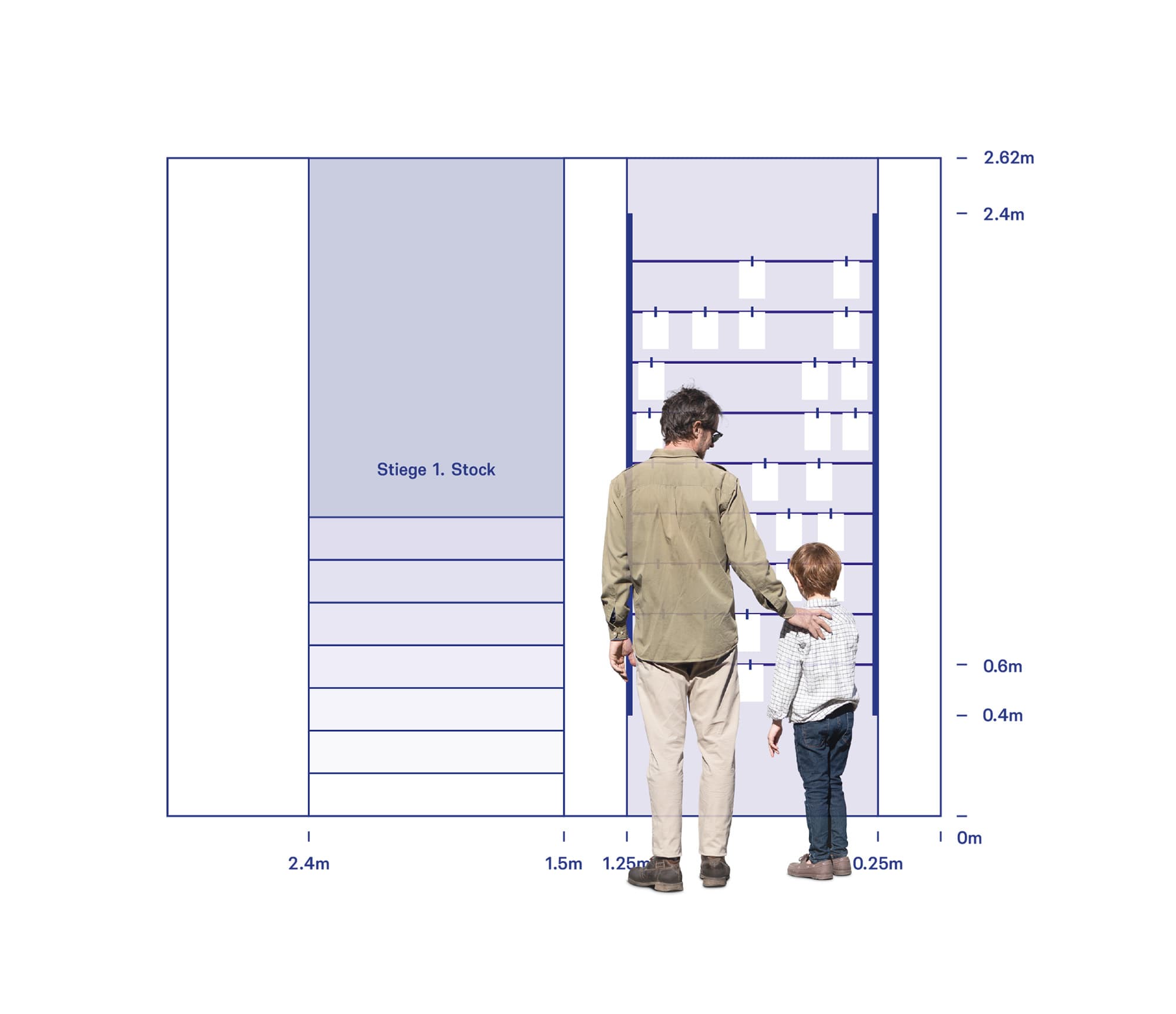
To the right of the projection, several shorter clotheslines are stretched one above the other. A display invites visitors to record their memories of the pool on a memory sheet and attach it to the clotheslines using clothespins. In this way, photographic memories are complemented by personal narratives. The atmosphere of the station is also acoustically supported by the sound of a swimming pool’s gentle splashing.
Station 2
Cultural memory
Station 2 focuses on cultural memory, meaning the collection of memories attached to objects such as photographs or documents, which can be found in archives or libraries. During the conception of the exhibition, it became clear that the history of the Margaretenbad is documented through a large number of commemorative items. Due to their abundance, it was not possible to include all of these historical testimonies in the exhibition. Therefore, the materials were reviewed and a selection was made. Based on this selection, six thematic focuses were developed that have significantly shaped the history of the Margaretenbad.
A new culture of the body – construction and opening of the Margaretenbad
Antisemitism and persecution – attack on the Margaretenbad
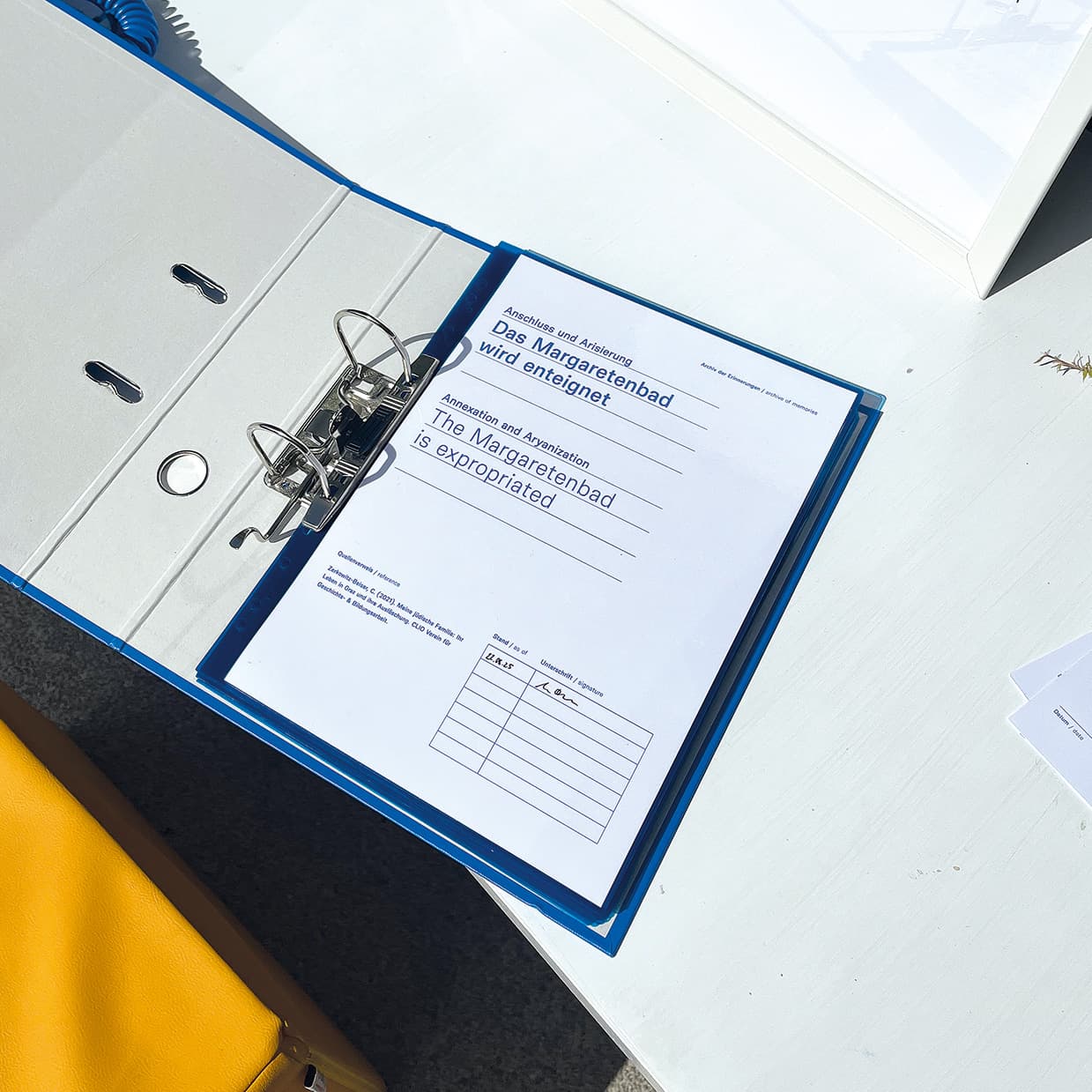
Annexation and “Aryanization” – the Margaretenbad is expropriated
Forgotten architecture – the Margaretenbad in transformation
“The Margerl must stay” – initiative to preserve the Margaretenbad
More than a swimming pool – play, fun, and sport at the Margaretenbad
The archive
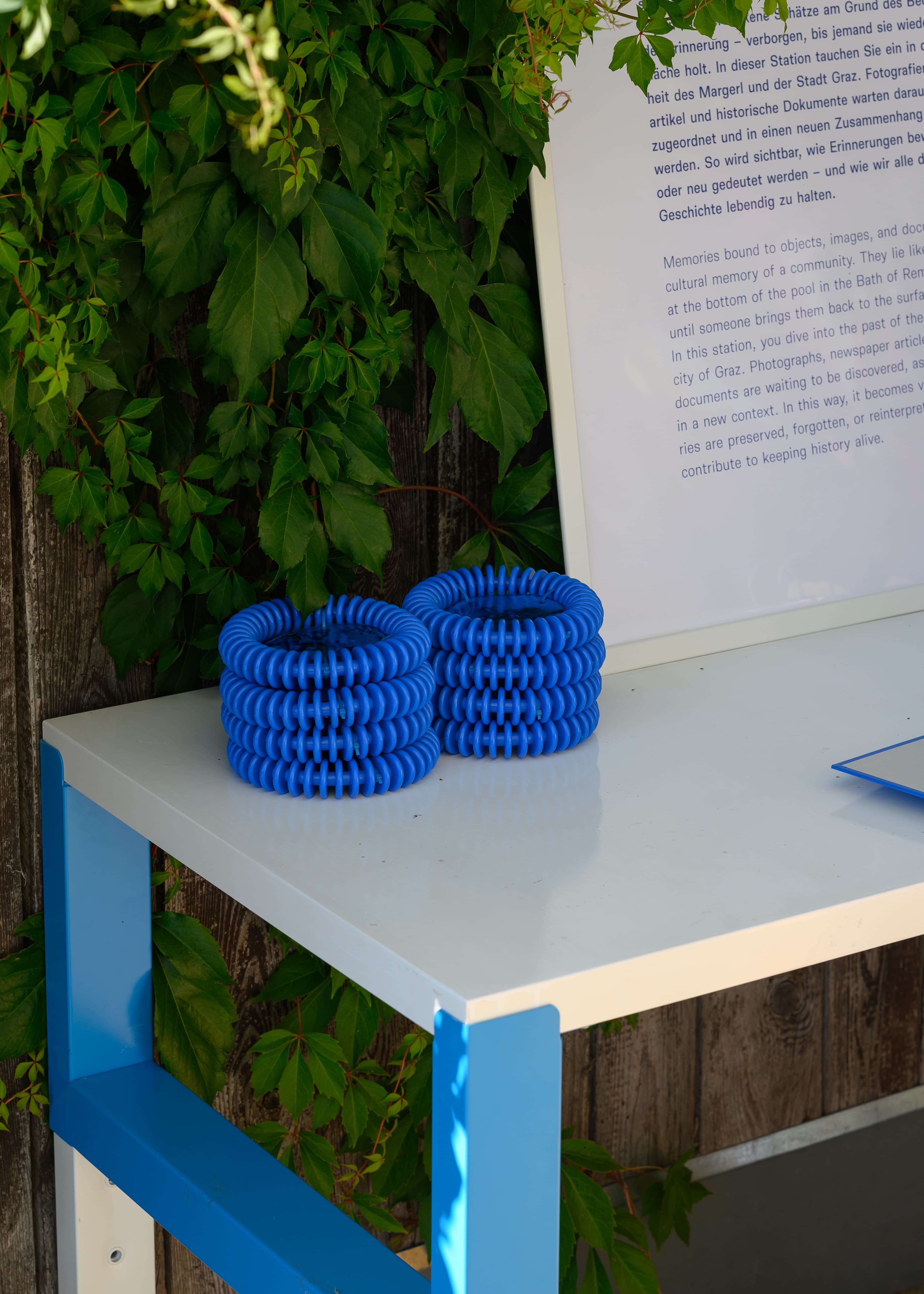
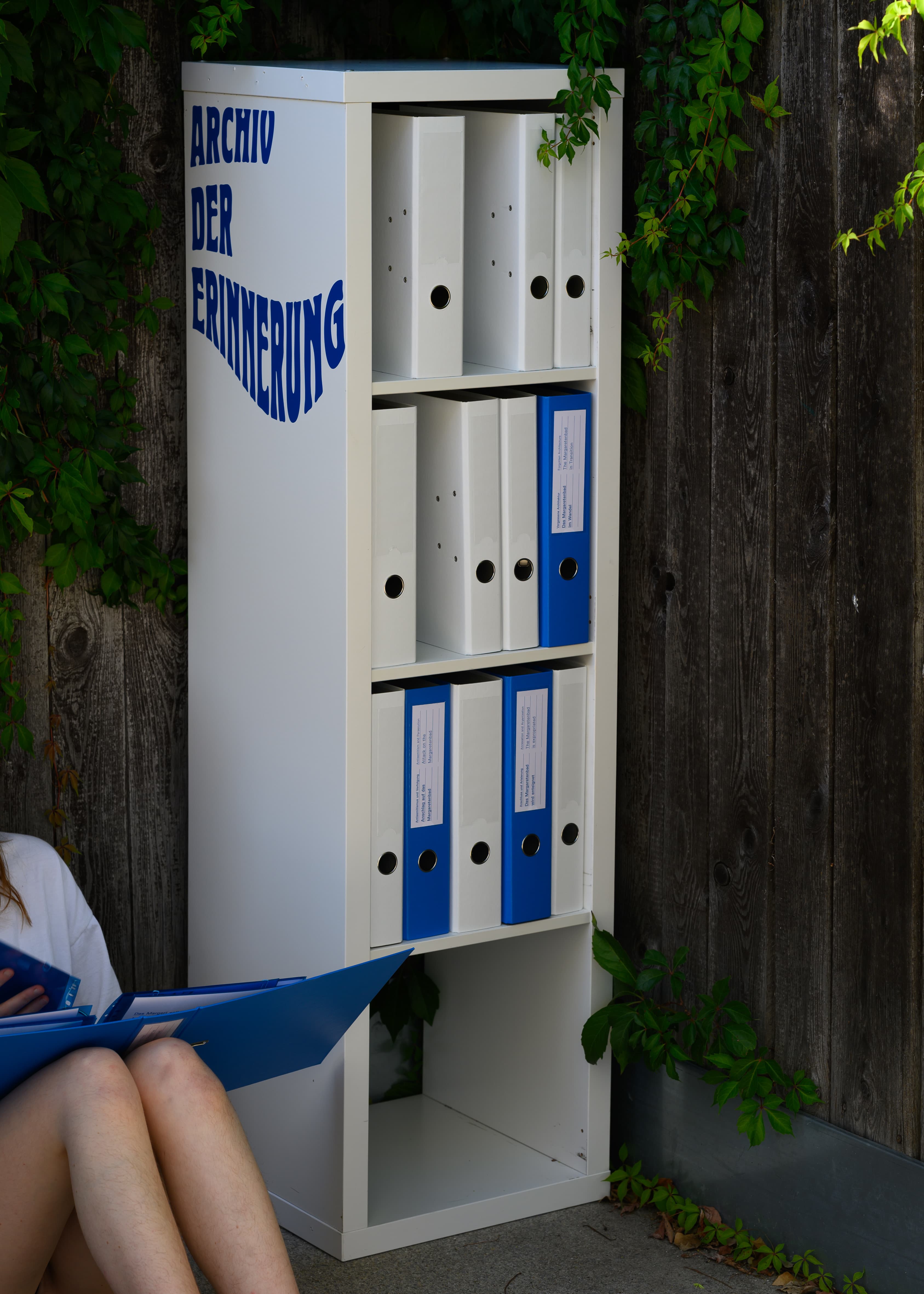
In the design of Station 2, the concept was based on an archival workspace. A white desk with a yellow seating element invites visitors to take one of several file folders from the archive shelf and conduct their own research. The white archive shelf contains both white and blue folders, but only the blue folders are labeled and can be removed by visitors. The white folders are permanently fixed in place and serve as design elements. On the side of the archive shelf, the name of the station “Archive of Memories” is displayed.
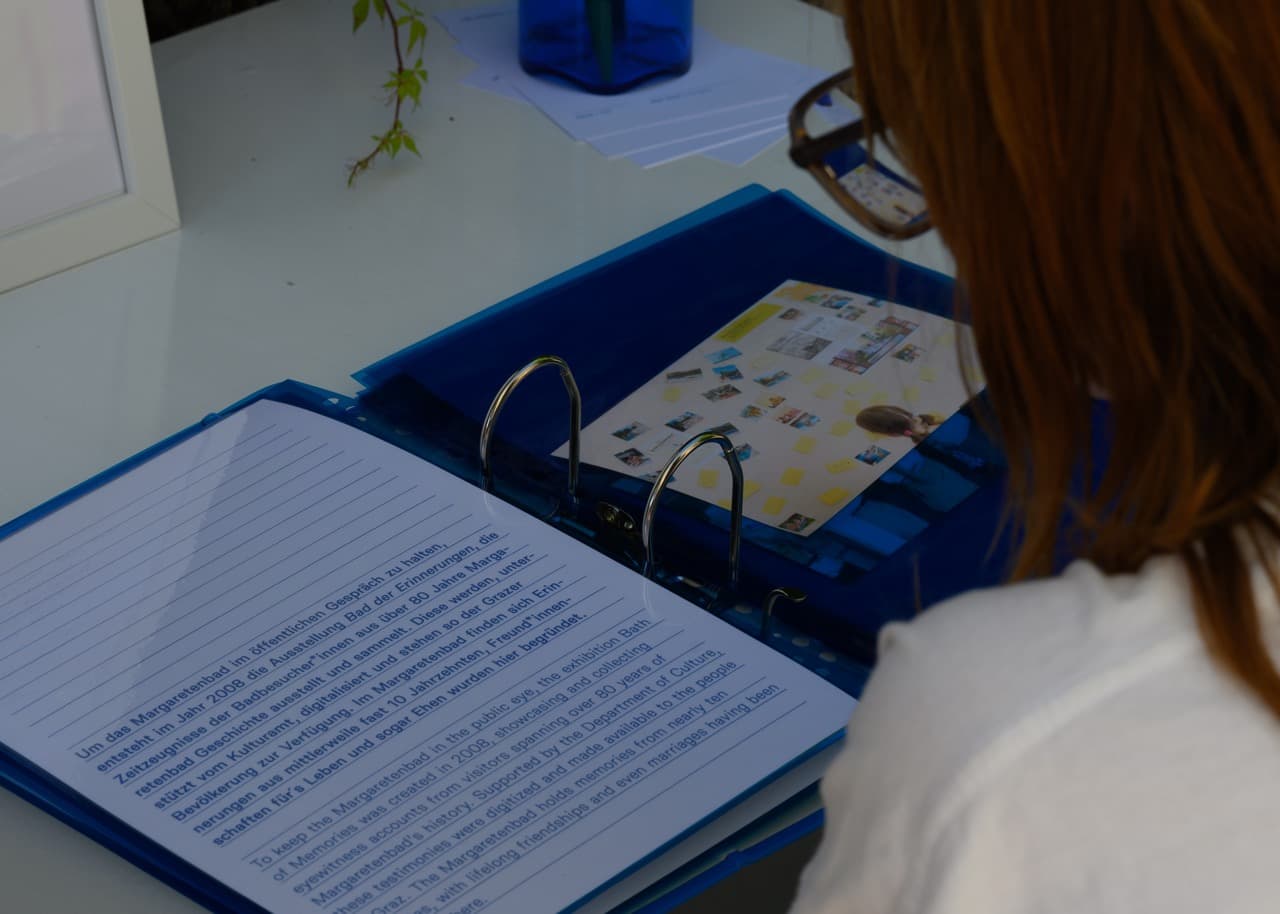
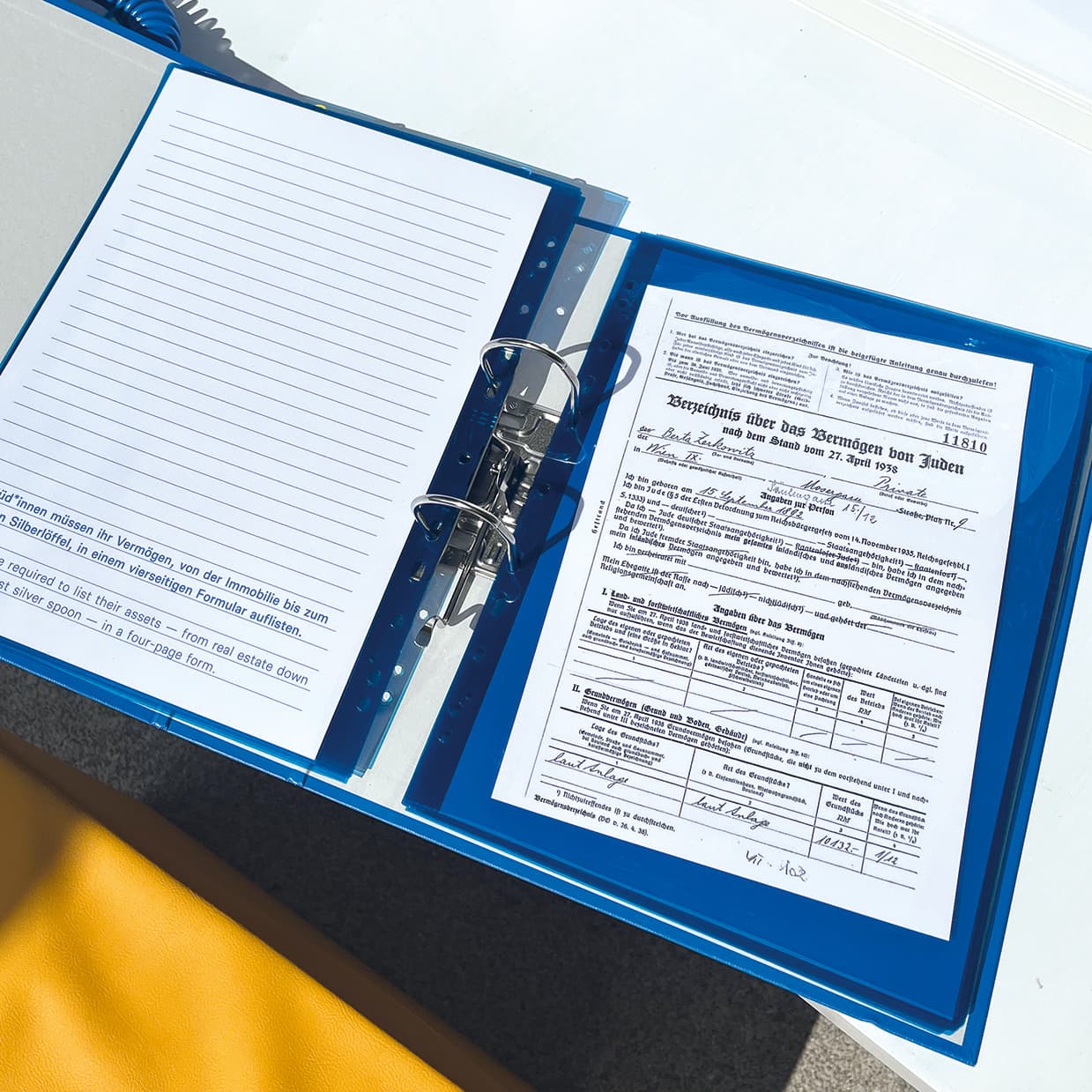
The six blue folders are uniform in design. Both the layout and the content were also based on archival files as found in real archives. Each folder contains a cover sheet, informational texts, and associated images. All pages of the folders were laminated to ensure that they would not wear out when handled by visitors with wet hands from the pool.
In eight of the images presented in the folders, circular sections are missing.
Sunk memory
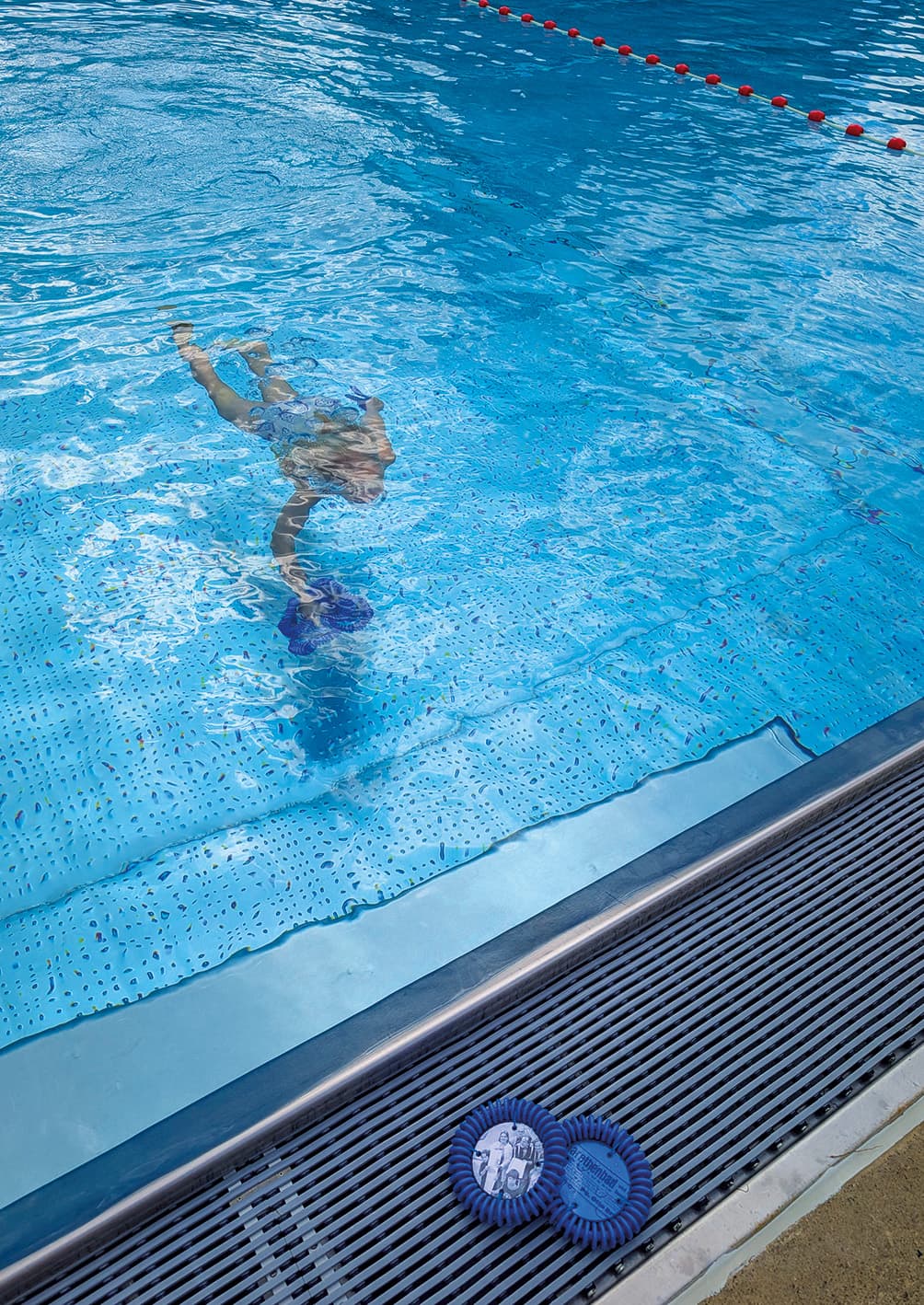
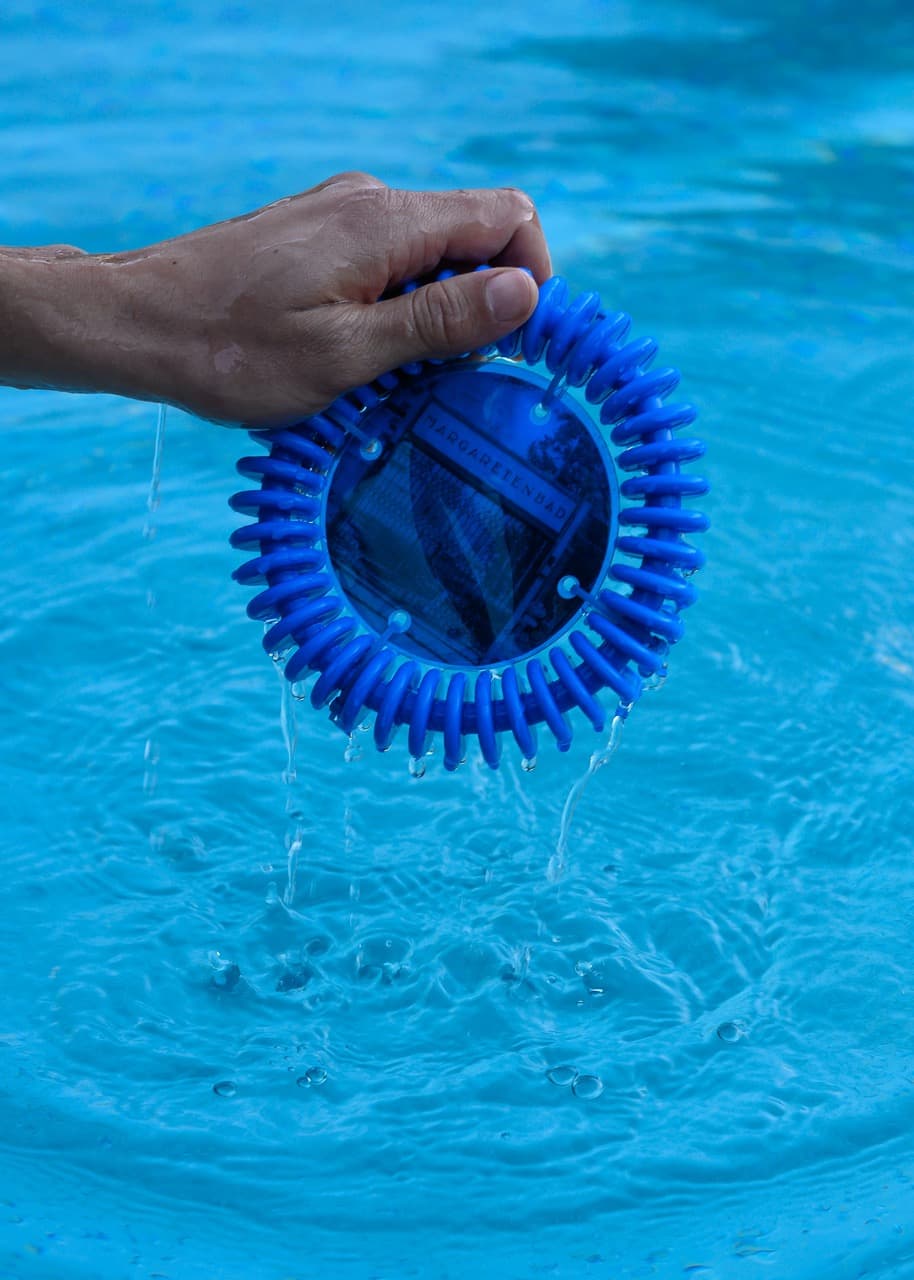
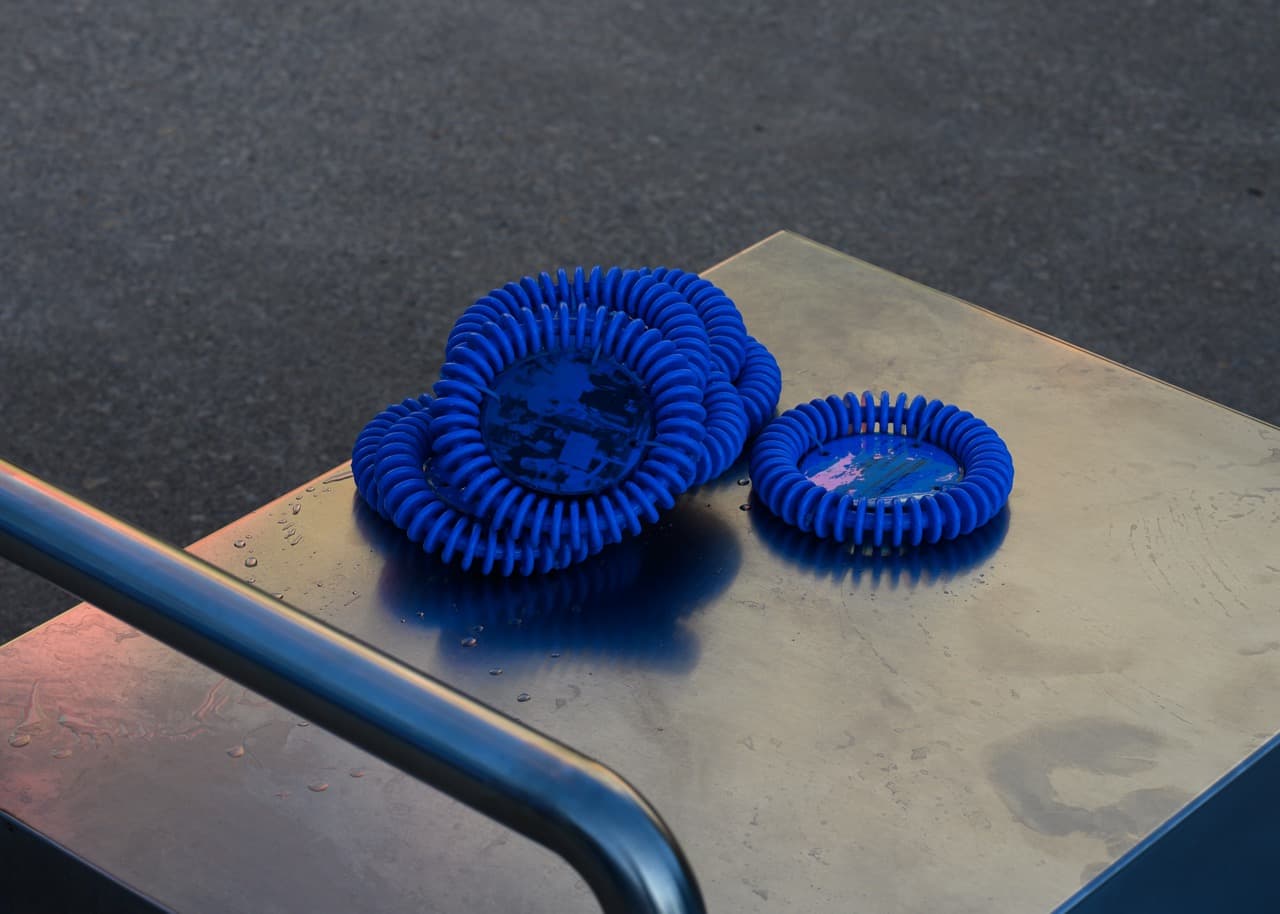
By indicating that this memory has sunk, visitors are invited to bring the submerged memory back to the surface. This refers to the diving rings, which are another essential component of the station. In the non-swimmer area of the pool, which is located directly next to the station, eight diving rings are sunk into the bottom of the pool. In the center of the diving rings, circular laminated images are inserted. They form the missing parts of the incomplete archival images in the file folders.
In this way, visitors are literally invited to dive for the submerged memories and thus complete the archival documents. The station therefore encourages interaction with other visitors while simultaneously integrating the architecture of the pool as an active part of the exhibition. At the same time, a metaphorical layer is opened up in which submerged or forgotten memories can only be brought to the surface by committed and interested individuals. This creates a symbolic act that illustrates that only an active culture of remembrance can preserve the past from being forgotten.
Station 3
Family memory
Station 3 focuses on family memory as a form of social memory. Through audio-recorded postcards and letters, visitors can trace the family history of the Zerkowitz-Beiser family, who built the Margaretenbad in 1927. The letters are read by Claudia Beiser, the great-granddaughter of Alexander and Jenny Zerkowitz, and her son Niko Beiser.
The selection of the letters was based on the book “My Jewish Family: Their Life in Graz and Their Erasure”, which publishes numerous personal letters. Through a selection process, a total of twelve letters were chosen and assigned to four thematic focuses. Each thematic focus forms an audio station and is explained through a title and an accompanying informational text.
Family conversations
The third station incorporates various design elements typically found in a family context. On one side of the station are small lockable private cabins that can be rented by bathers for the season to store personal belongings. Four of them conceal listening stations, which form the central element of Station 3.
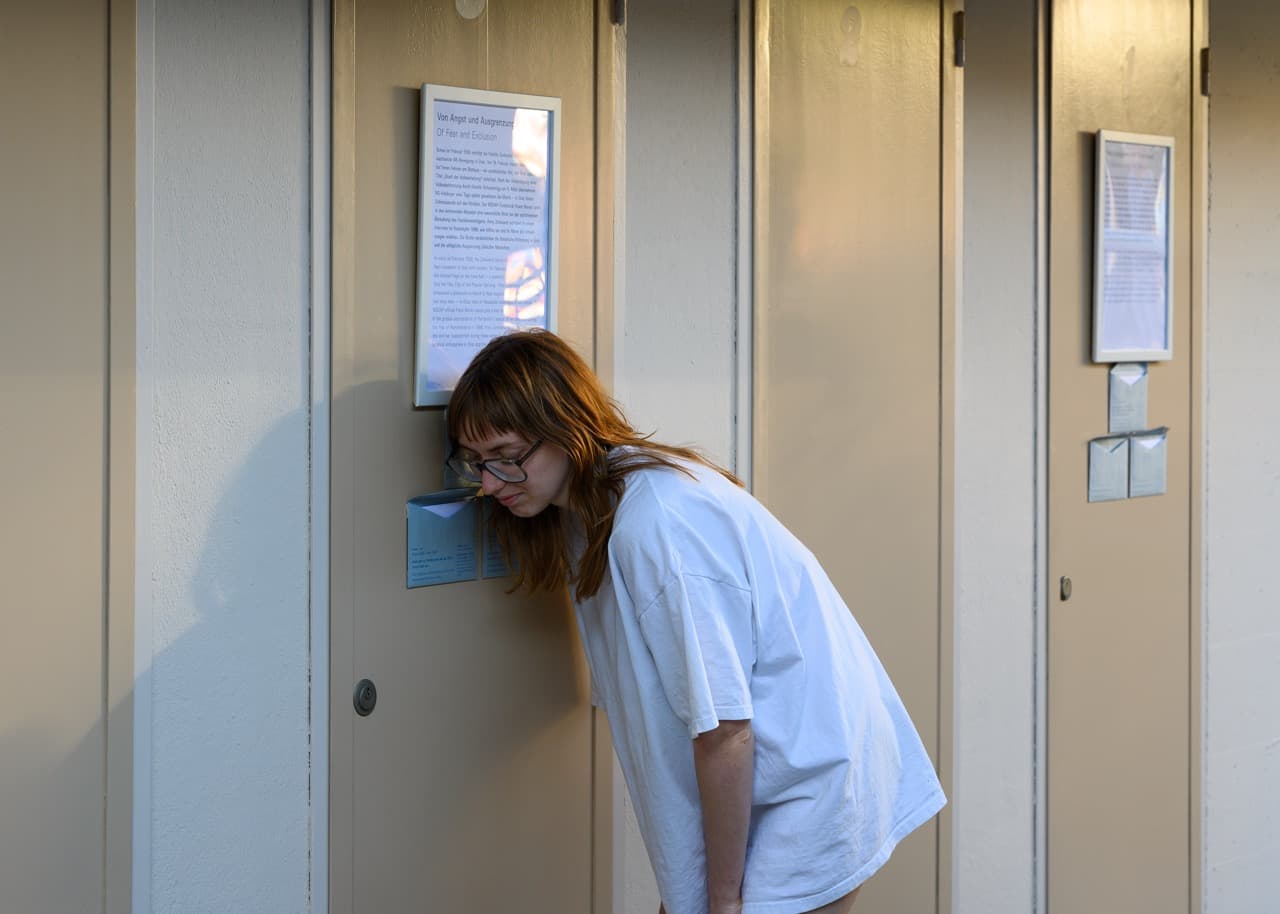
The private cabins were deliberately chosen for the implementation of these listening stations, as the audio-recorded letters heard there provide insight into the most private sphere of the Zerkowitz family. For the technical implementation of the listening stations, contact speakers were used. These make it possible to turn almost any surface into a loudspeaker.
The contact speakers, which were mounted on the inside of the cabin doors, translate the audio track of the spoken letters into mechanical vibrations and transmit these vibrations directly to the cabin door. In this way, the door itself becomes a resonating body.
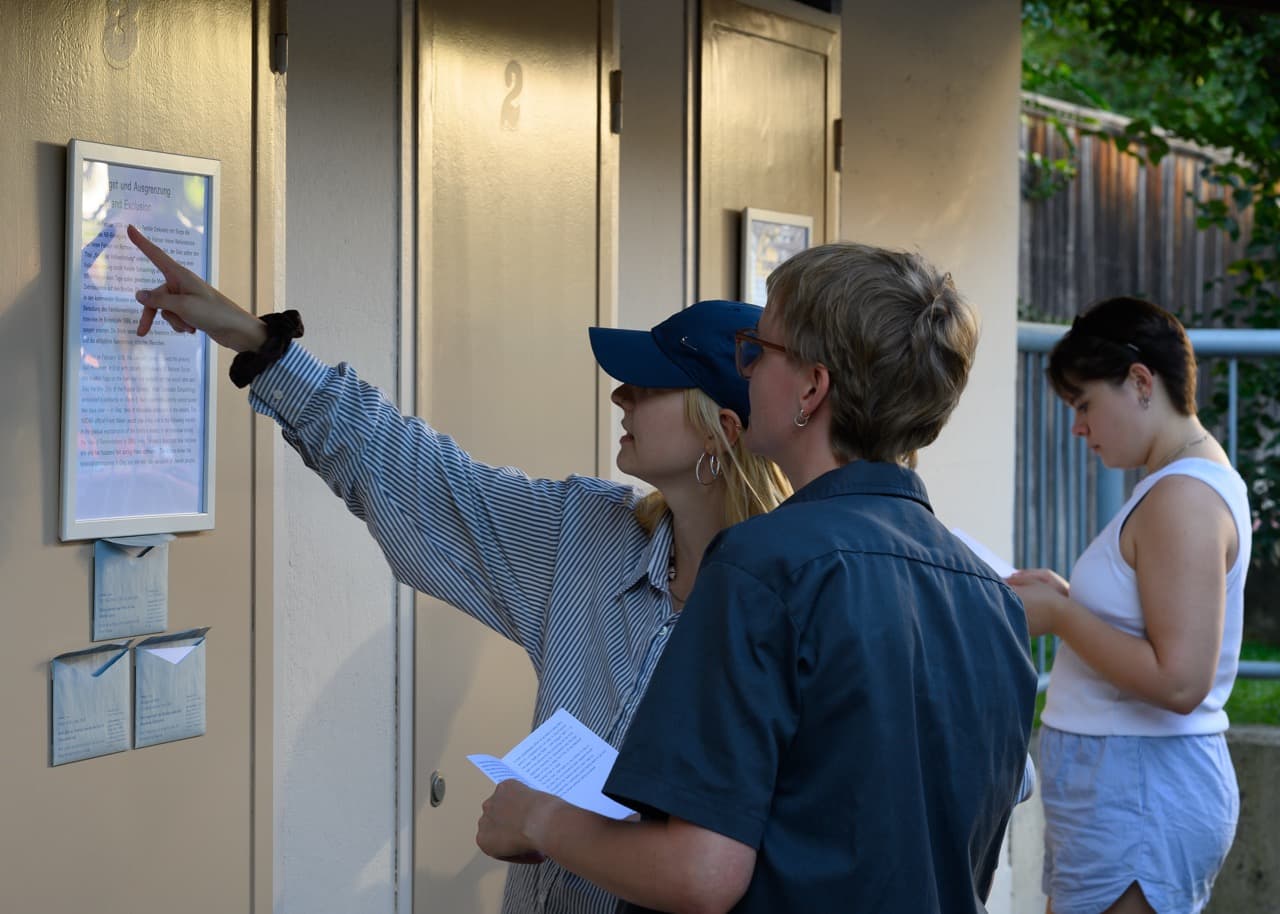
On Expropriation and Resistance
This listening station addresses the “Aryanization” of Jewish property in Graz, which also affected the Margaretenbad and its owners. A letter from Jenny Zerkowitz from 1939 shows her resistance against the targeted devaluation of the bath. After the war, Anny Zerkowitz received the heavily damaged and looted bath back. In her notes from June 1945, she describes the condition after its takeover. The letters highlight the violent theft of Jewish property and the importance of the bath for the family.
On Fear and Exclusion
This listening station illustrates the National Socialist atmosphere in Graz from the perspective of the Zerkowitz family. In an interview conducted in 1988, 50 years after the so-called “Anschluss” of Austria, Anny Zerkowitz describes how helplessly she and her husband experienced the upheavals. The letters reveal the fanatical atmosphere in Graz and the everyday exclusion of Jewish people.
On Persecution and Love
This listening station traces the fate of Bruno Zerkowitz, who was arrested during the November pogroms and deported to Dachau. In a letter, he writes from the camp, implicitly asking his wife to look into escape possibilities. After his release on the condition that he leave the country, he fled to Yugoslavia in September 1939. With the German invasion in 1941, the situation there also worsened. In his letters, Bruno Zerkowitz describes his concern for his family, his love for his son Klaus, and his longing for reunification. The letters make the personal suffering and love of a family during times of persecution and displacement audible.
On Concern and Hope
This listening station addresses, through the example of Elsa Zerkowitz, the difficult escape of Jews from Austria. The youngest daughter of Anny and Alexander Zerkowitz submitted an emigration application to the Jewish Community in Graz on July 14, 1938. In May 1939, she succeeded in fleeing to England. She remained in contact with her family, especially her sister-in-law Anny. Her sister Sylva stayed in Vienna, threatened by Aryanization, economic hardship, and the constant danger of deportation. Her letters to Anny in Graz testify to concern for the family, harsh living conditions, and hope for a safe future.
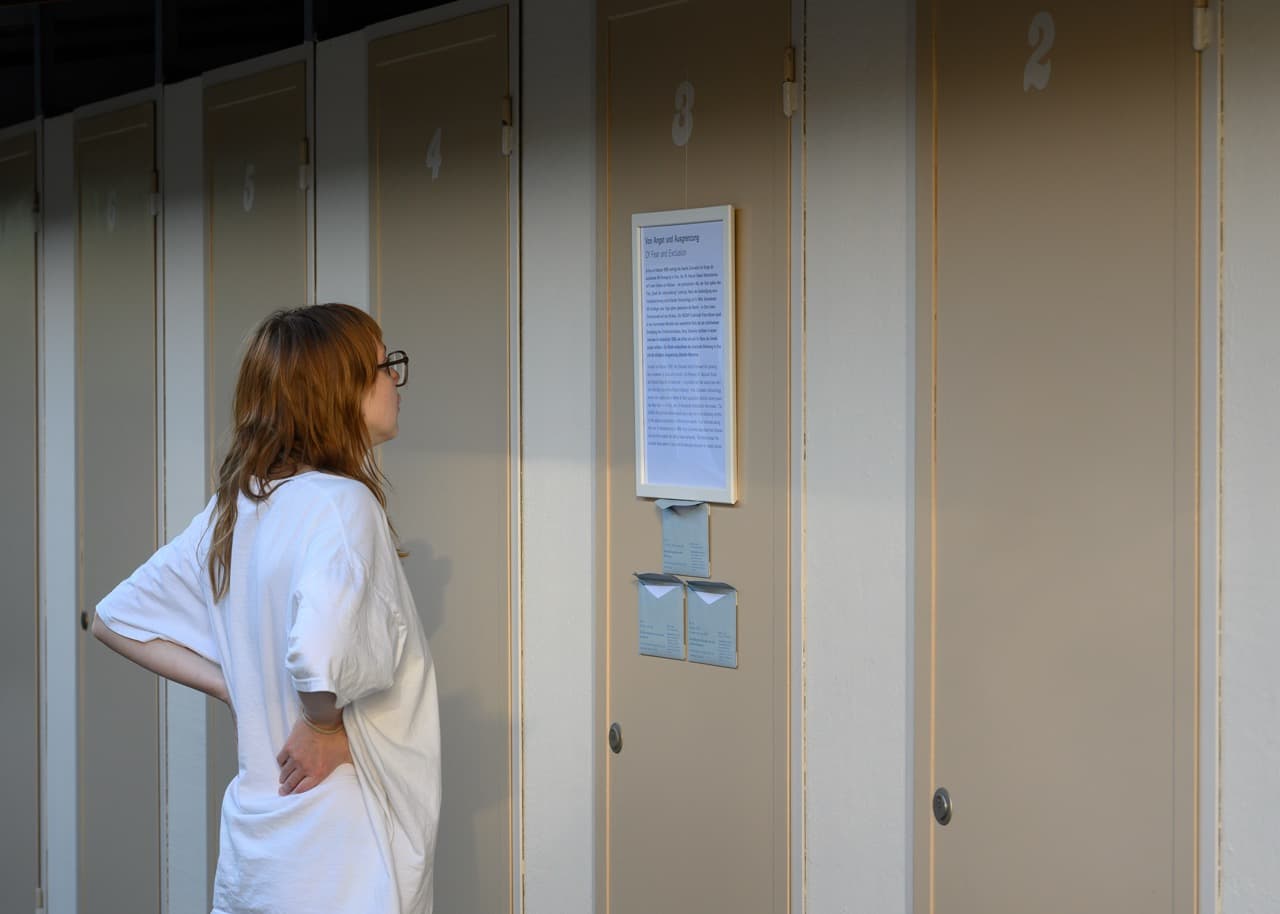
By placing their ears against the locked cabin doors, visitors can listen to the audio-recorded letters. Through the use of contact speakers, the impression is created that visitors are eavesdropping on the cabin doors, which in turn emphasizes the intimacy of the content being heard. By listening in, visitors participate in various private conversations and themselves become witnesses to the family history.
The locked cabins represent the exclusivity of family memory, which is usually closed off and reserved only for family members. On the outside of the cabin doors, envelopes are attached which contain the respective family letters in written form. This allows visitors to read along with the letters while experiencing them audibly.
Family Gallery
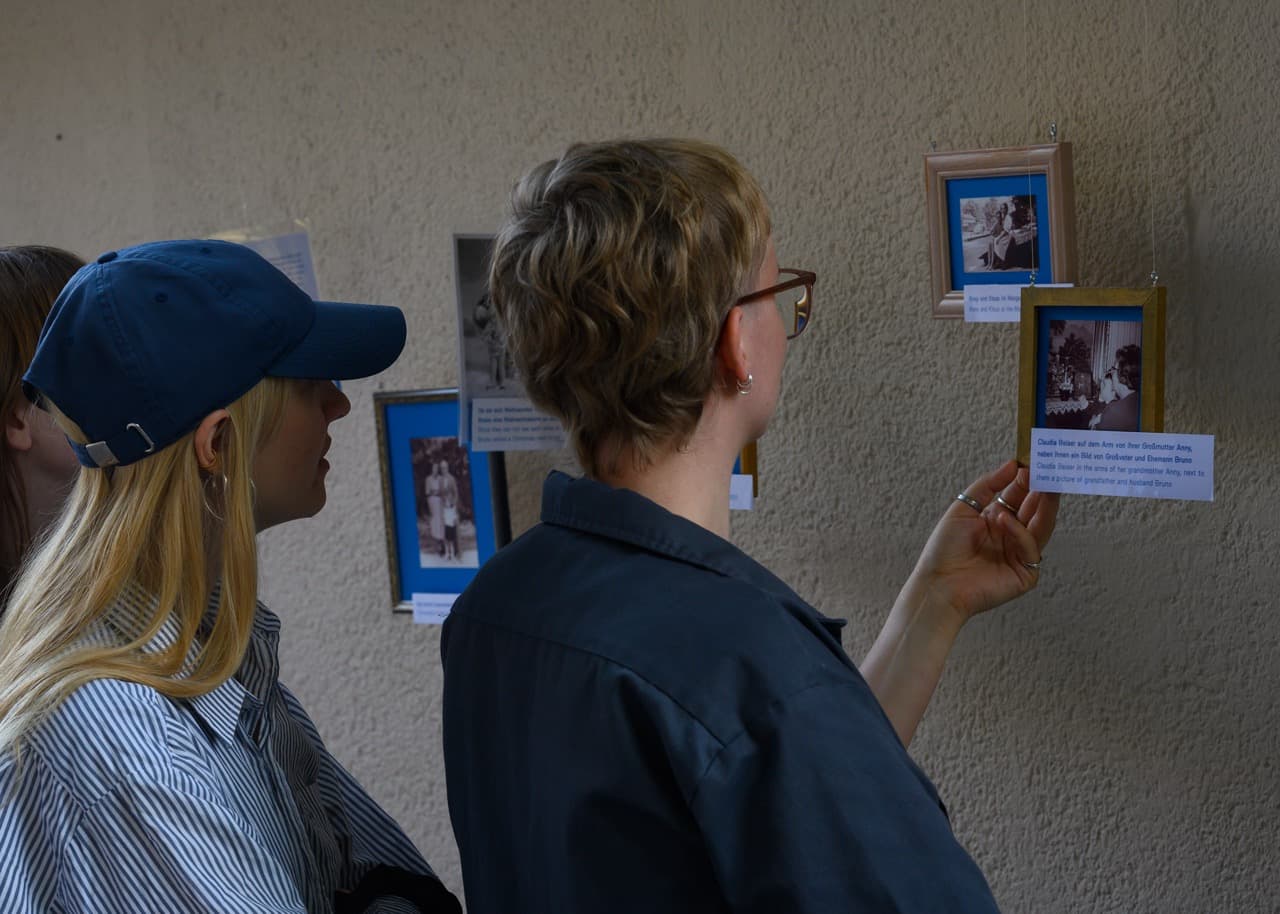
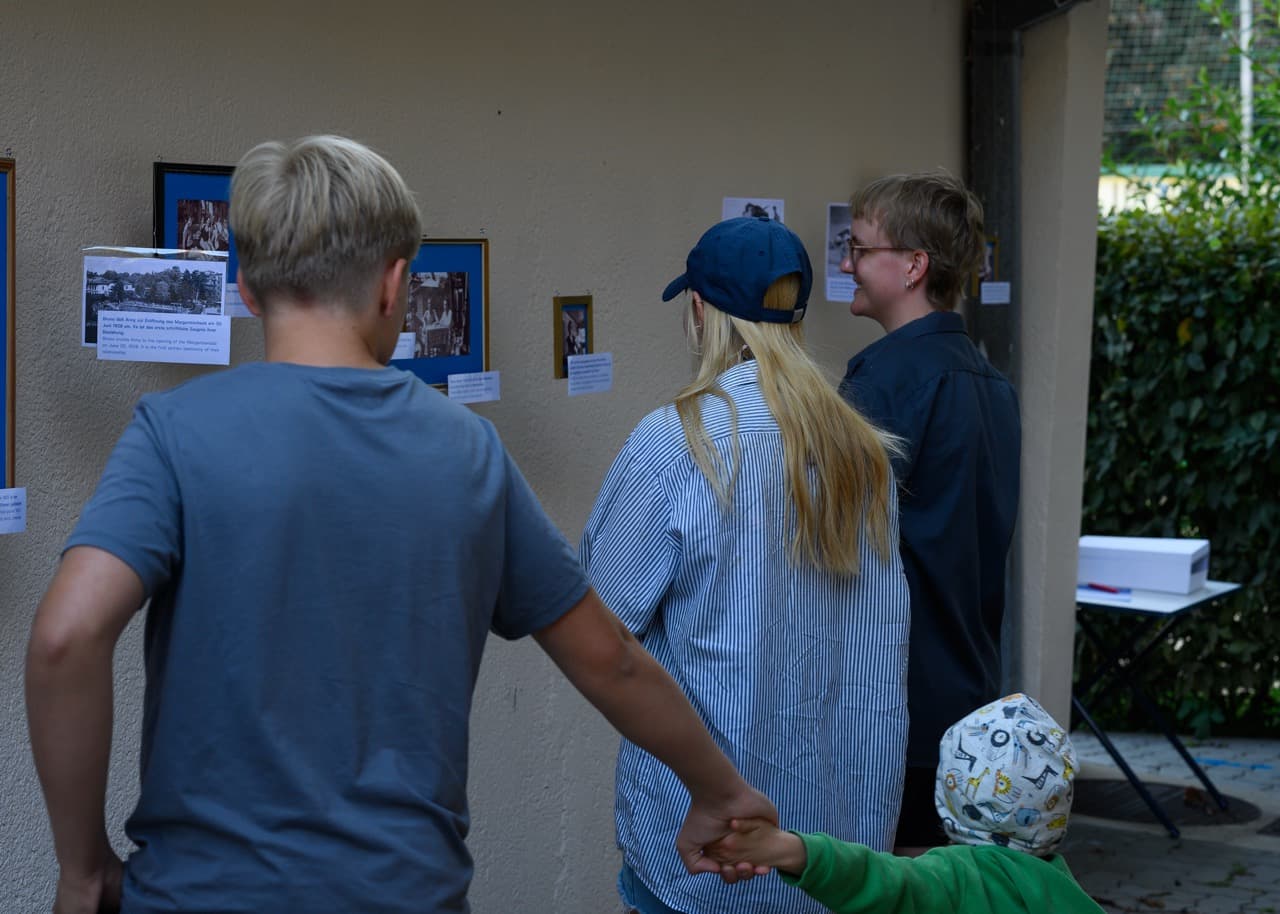
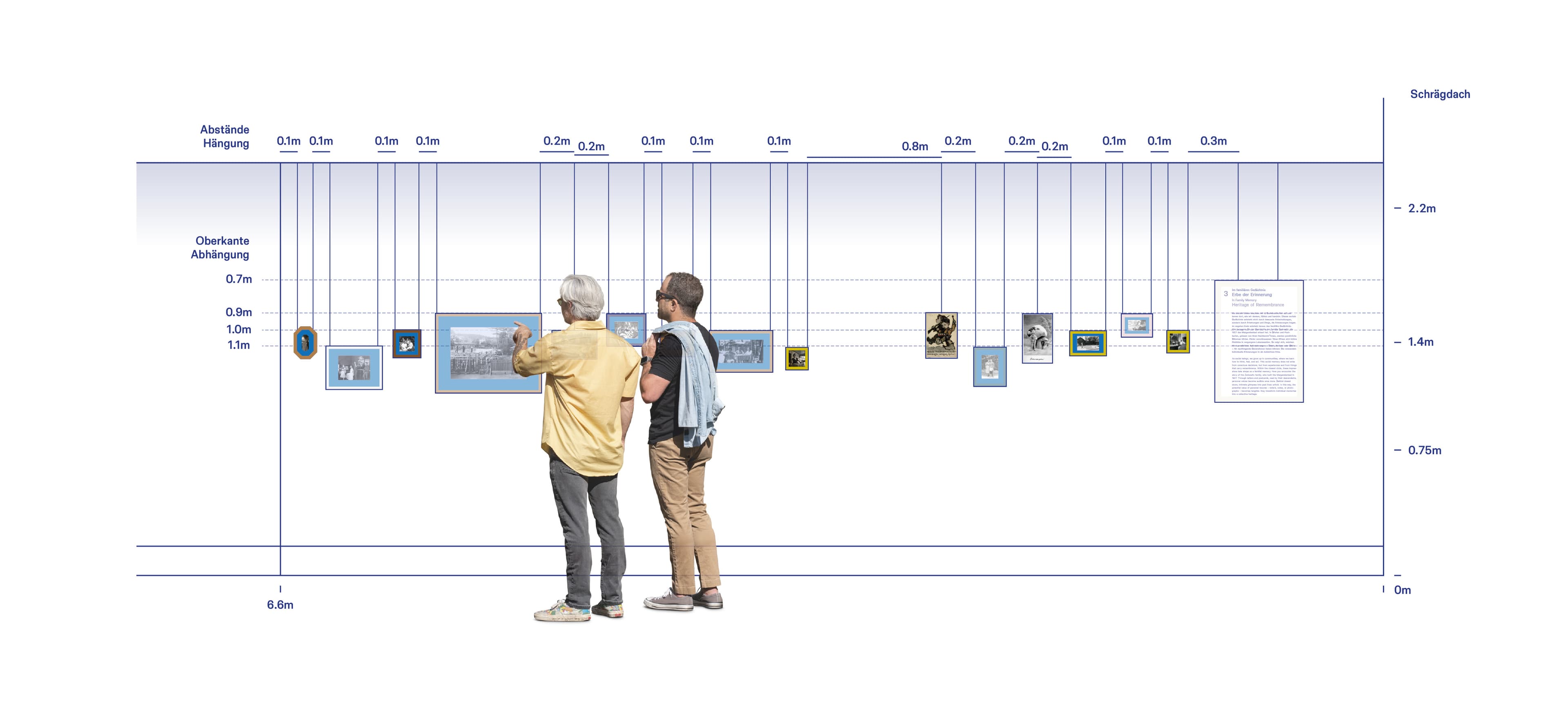
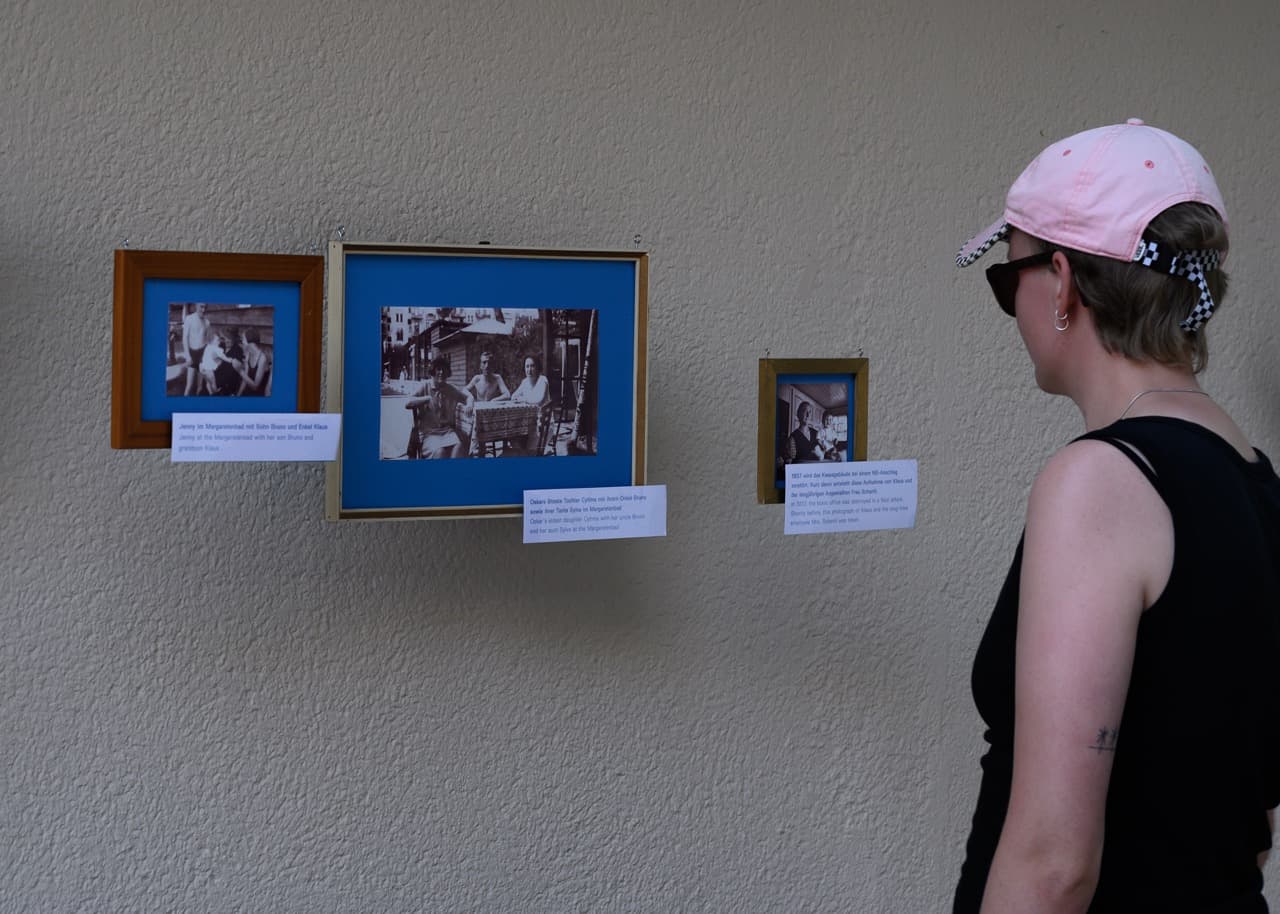
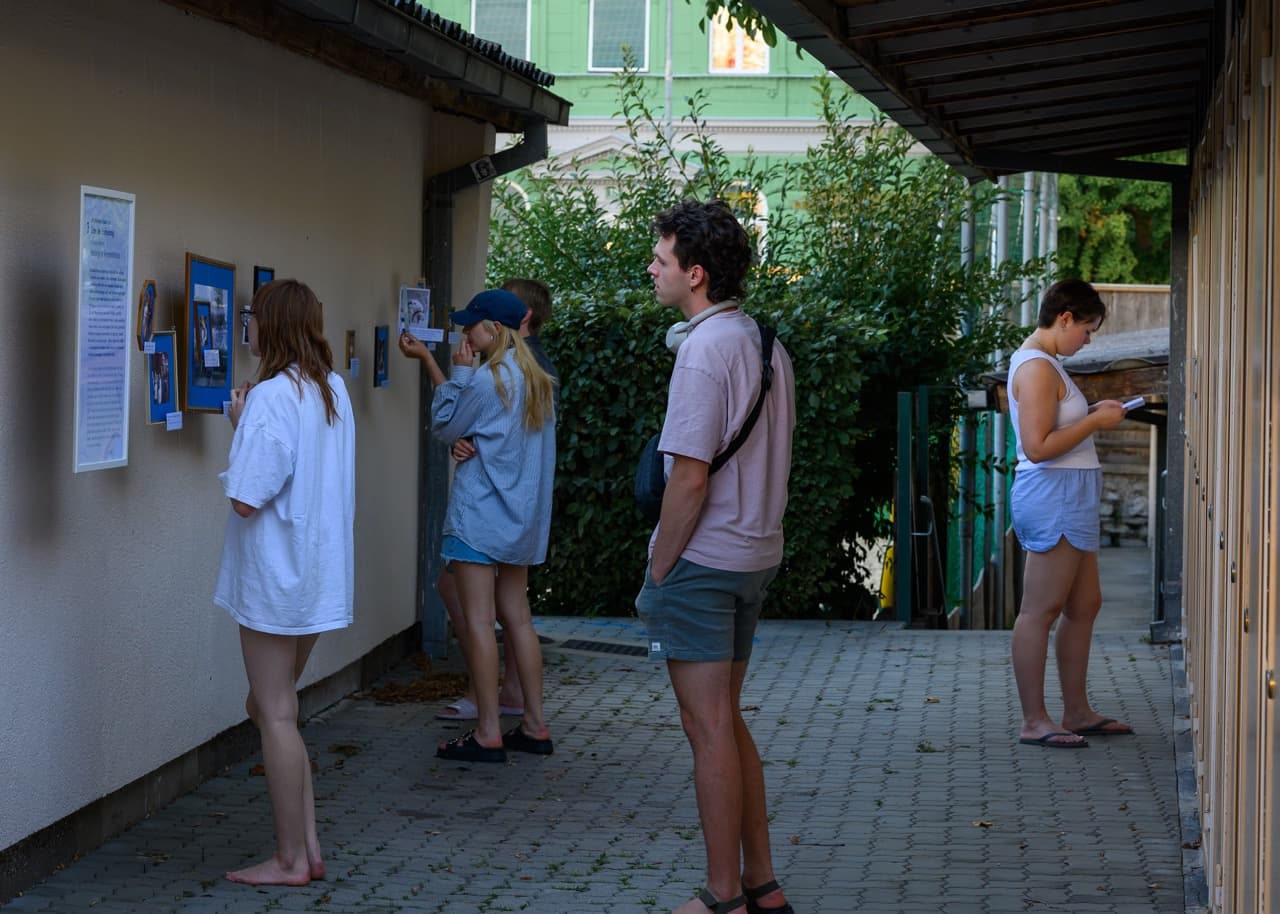
Opposite the listening stations, there is a display of historical photographs. Family portraits and other historical black-and-white photographs can be seen, showing various members of the family and suggesting the impression of a domestic family setting, as it might also be found in one’s own home.
This sense of familiarity is reinforced by the framing of the images in old wooden frames, which create the impression that they have long been in the family’s possession. In contrast to the historically familial design, the images are presented against a blue background. In this way, the antique impression of the black-and-white photographs is disrupted by the strong blue, while at the same time integrating the character of the exhibition.
The frames also include labels that place the photographs in a temporal context. The hanging arrangement is based on a salon-style hanging. As a result, there is no clear top or bottom edge, and the images are arranged in a free grid. This creates the impression of a display more typical of a domestic, family context rather than a museum setting.
Communication
Poster Design
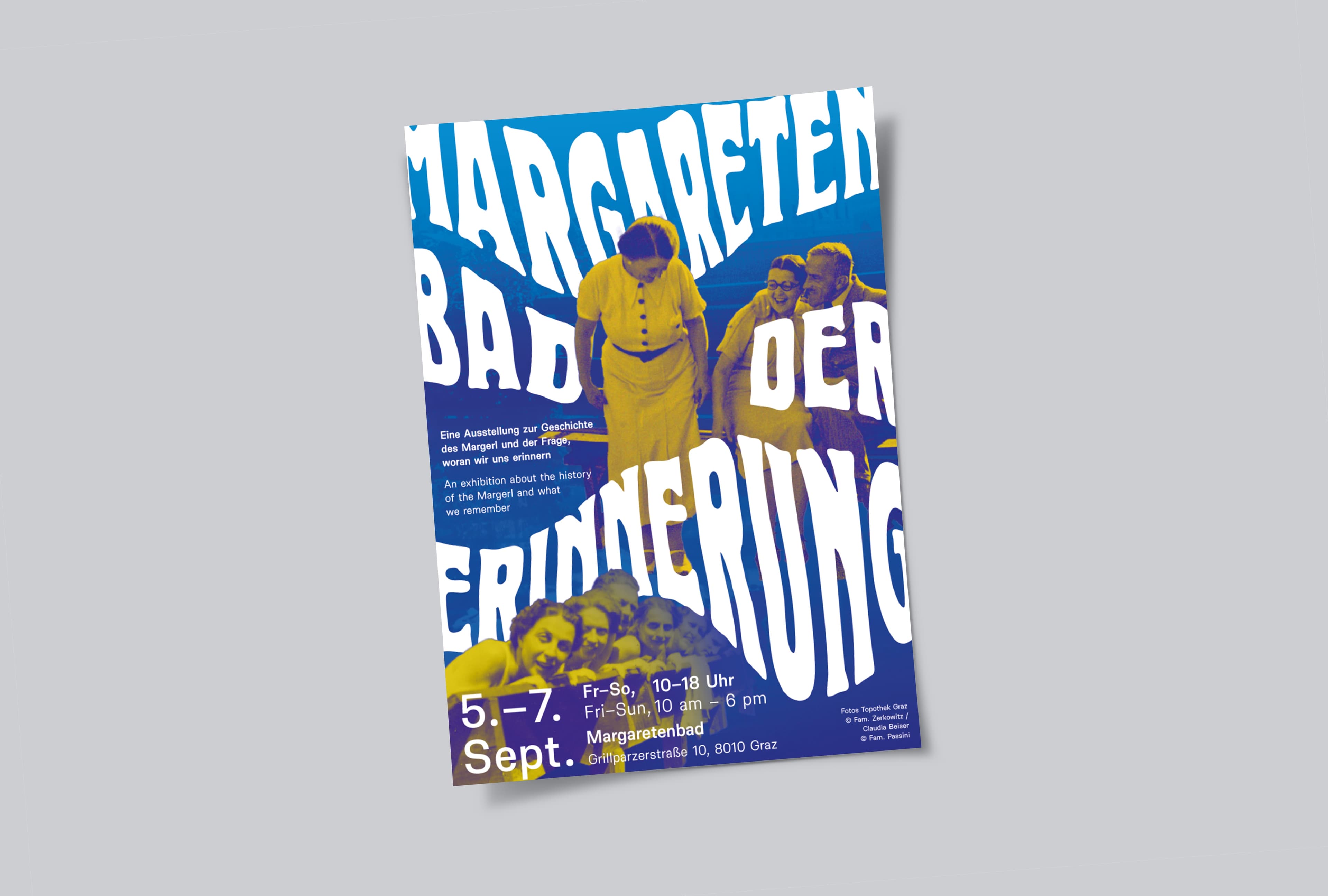
The poster combines the title of the exhibition with historical images of the Zerkowitz family and other bathers. In designing the poster, the focus was deliberately placed on people—those who continue to shape the bath to this day—rather than on the bath itself.
The people appear in a radiant yellow tone, giving the poster warmth and liveliness, while the blue background, combined with the fluid typography, references flowing water and transience.
Challenges and potentials
Designing an exhibition for a public swimming pool — a space defined by routine, leisure, and movement — presents unique challenges and powerful possibilities. Unlike traditional exhibition venues, a pool is not a neutral backdrop. It is a living, functional place where people come to swim, relax, and socialize. This everyday setting requires a delicate balance between visibility and subtlety, intervention and integration. One of the central difficulties lies in addressing serious historical and emotional themes — such as personal and cultural memory or the Nazi past — in a space not typically associated with reflection. The environment resists stillness: sounds echo, surfaces are wet, and attention spans are fleeting. Exhibits must work within these limitations, becoming part of the space without disrupting its flow. Materials must be water-resistant, formats flexible, and messages clear enough to reach visitors in motion. And yet, this very informality holds enormous potential. The pool allows memory to surface in unexpected ways — in towels hung up, in lockers, in whispered audio behind closed cabin doors. The contrast between the casual setting and the depth of the content can open up space for curiosity, surprise, and emotional connection. Memory becomes something visitors stumble upon, rather than seek out — making the encounter all the more powerful. The pool also invites a broader and more diverse audience than traditional museums. It encourages participation from people of all ages and backgrounds, many of whom may not usually engage with historical exhibitions. Through playful and interactive formats — like diving for historical documents or listening to family stories in private cabins — the exhibition becomes both accessible and meaningful. Ultimately, the project turns the Margaretenbad itself into a memory space: layered, collective, and alive. It shows that history is not confined to monuments or archives — it lives in the everyday, in places we often overlook. Designing for such a site demands sensitivity, creativity, and care — but it also offers a rare chance to bring memory into motion, right where life happens.